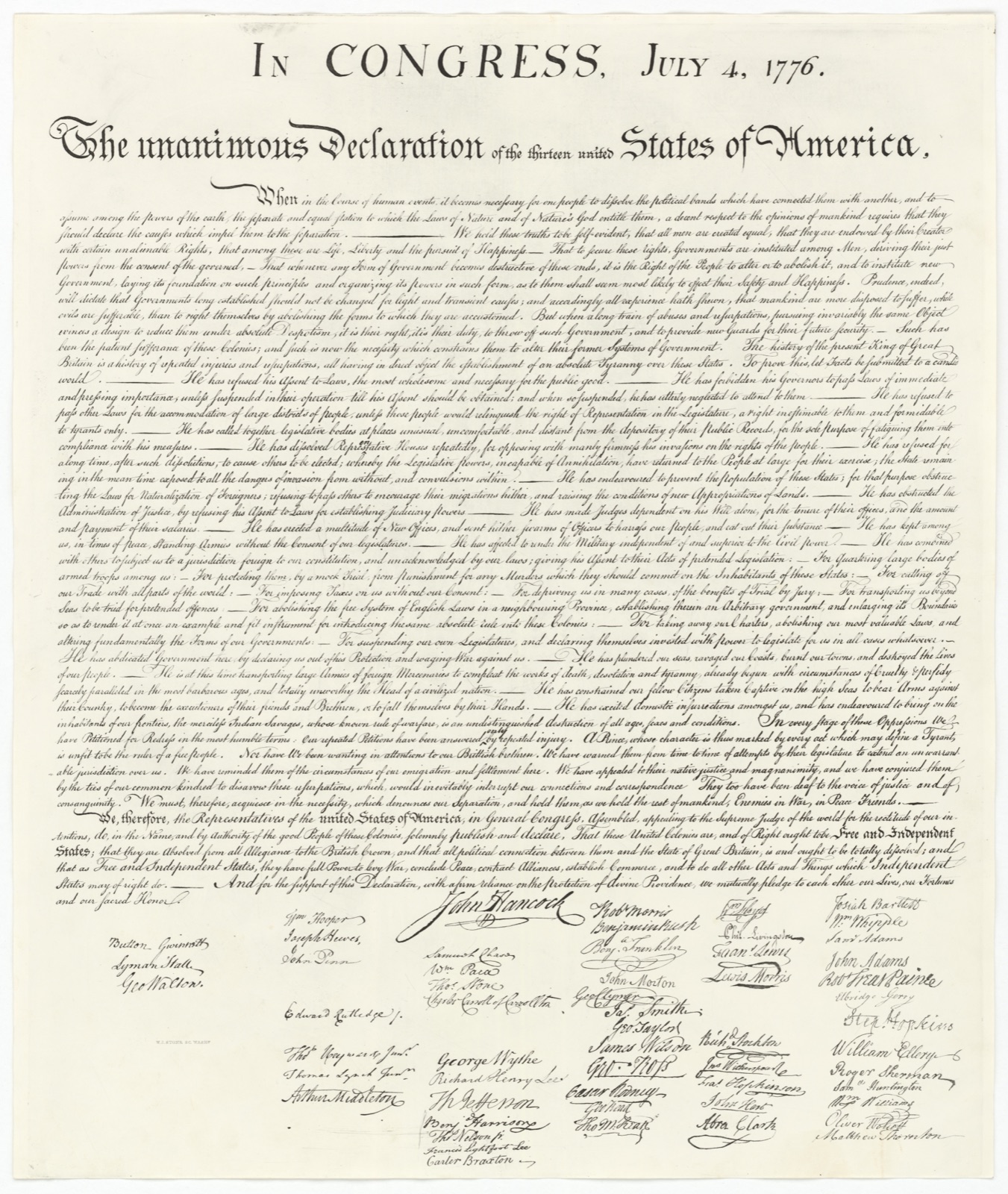
Two hundred and fifty years ago today, the Continental Congress adopted a document that was, at its heart, a fact pattern. We remember the Declaration of Independence for its soaring preamble, but most of its text is something far less poetic: a numbered indictment. Twenty-seven specific grievances against a ruler who considered himself above accountability: obstructing justice, corrupting the administration of government, placing his own interests above the law. The founders did not merely declare their feelings. They documented their case, put their names to it, and staked everything on the proposition that a free people, presented with the evidence, would act.
I have been thinking about that document all week, because this Fourth of July is not an ordinary one. It is the nation's semiquincentennial, marking 250 years of the American experiment, and I believe the most patriotic thing I can do today is what those founders did: put my name to a documented case, and invite my fellow citizens to render a verdict.
The 250-Year Question
Every generation of Americans has faced some version of the same test: does self-government survive contact with a leader who holds himself above the law? The Civil War generation answered it. The generation that confronted Watergate answered it. The question is never settled permanently, because the temptation of unaccountable power is never settled permanently. It only waits for institutions to weaken and citizens to look away.
In 2026, the question has returned in its most concentrated form in modern memory. And this November, in the midterm elections, the American people will answer it, whether they intend to or not. The only choice is whether we answer it deliberately.
The Record
The founders numbered their grievances. This record is organized the same way, in three categories, and what follows can be stated plainly, without adjectives, because the evidence says it for us.
The first is false claims: factual assertions about the economy, elections, immigration, the rule of law, health, and foreign policy, contradicted by authoritative evidence and often by the government's own published figures.
The second is corruption: documented incidents in which public office was used for private gain, by the officeholder, his family, and his appointees.
The third is abuse of power: documented incidents in which official authority was turned against the courts, elections, inspectors general, and the lawful checks on the executive.
Not opinions. Not predictions. Not spin, which every politician produces. Every entry rests on primary documents, carries a tier rating for the strength of the evidence behind it, and is open to inspection.
Three examples, one from each category:
At this year's State of the Union, the President told Congress, "In 12 months, I secured commitments for more than $18 trillion pouring in from all over the globe." His own White House's official investment-tracking page listed $9.6 trillion that day, roughly half what he had just told Congress. Both numbers are the administration's own, and only one can be correct.
He announced a new White House ballroom to be paid for entirely by private donors at a cost that grew from $200 million to $400 million. On March 31, 2026, his defense was blunt: "This is taxpayer-free. We have no taxpayer putting up 10 cents." In June 2026, the Washington Post reported internal contractor estimates and federal payment records putting the total at $600 million, roughly $307 million of it public money: $155 million from the Secret Service, $149 million from the White House Military Office, and $3 million from the Executive Residence.
In September 2025, after a three-day trial, U.S. District Judge Charles Breyer ruled that the administration's use of federalized National Guard and Marine forces for civilian law enforcement in Los Angeles violated the Posse Comitatus Act, and ordered it stopped in California. The Ninth Circuit granted an administrative stay two days later. In December, Judge Breyer ordered the deployment ended, the Ninth Circuit declined to stay that part of his order, and the deployment ended on December 31, 2025. That is not my characterization or the site's. It is a federal court finding, after trial, that a specific federal statute was broken.
Each of these can be verified in minutes. Each has been verified by independent, authoritative sources. And each is one entry among hundreds of false statements, incidents of corruption, and incidents of abuse of power, every one held to the same standard of evidence.
None of this is about policy. You can favor higher tariffs, a stronger Presidency, or smaller government. Those are legitimate positions in a democracy, held by decent people, and this essay takes no side on them. What no citizen of any party should accept is a government that tells you things contradicted by its own published numbers, that uses public office to enrich the people who hold it, and that turns official power against the institutions meant to check it. Every claim above is sourced, and I will explain below exactly how you can check them yourself.
The Accountability Gap
The founders anticipated a leader like this. What they could not fully anticipate is how thoroughly the remedies they designed could be neutralized.
Impeachment has been attempted twice; a majority of Senators from the President's own party declined to convict both times. The courts move slowly, and their judgments can be delayed, appealed, and in some cases simply defied. Inspectors general can be fired. Prosecutors can be replaced. Institutional guardrails, we have learned, are staffed by people, and people can be pressured, purged, or persuaded to look away.
But there is one mechanism of accountability that cannot be vetoed, pardoned, fired, or appealed. It requires no majority of Senators and no ruling from any court. It is the mechanism the founders trusted above all others, and it arrives on schedule this November: the vote.
A Referendum, Deliberately
This is the idea behind Trexit: a national referendum on the Trump administration, conducted through the 2026 midterm elections.
The concept is simple. Trexit.org hosts two things. The first is the record: a public archive of the administration's false statements, corruption, and abuse of power, each entry documented, sourced, and organized by topic, published under a transparent editorial methodology. The second is a pledge: a public commitment to vote in November 2026 against candidates of any party who have enabled or condoned the administration's corruption and abuse of power.
Read the record. I think the evidence speaks loudly enough on its own. If it convinces you, take the pledge. That's it. Signing costs nothing: no contribution, no party registration, no rally to attend. A referendum needs only two things: evidence and voters.
Why the Enablers
Donald Trump is not on the ballot in 2026. The people who made his conduct possible are.
A president cannot corrupt the government alone. Every entry in this record, the false statements, the self-dealing, and the abuse of power alike, required members of Congress who declined to exercise oversight, who voted against accountability at every opportunity, who repeated statements they knew to be false because contradicting them carried a political price. Enabling is not a passive condition. It is a series of choices, made in public, recorded in votes, and votes are facts, too.
This is why the referendum framing matters. A midterm election is ordinarily hundreds of separate contests about hundreds of separate personalities. Trexit proposes that voters treat it as a single contest over a single question: Should the people who enabled this record be returned to power? When enough voters answer that question together, visibly, in advance, the election stops being a referendum conducted by accident and becomes one conducted on purpose.
Don't Take My Word For It
I am writing this as a concerned citizen, and I ask that you place no trust in me at all. I founded Protect American Democracy, the organization behind Trexit, which is why the design matters more than my word.
Every claim in the Trexit record links to its sources. The editorial methodology is published in full: what qualifies a statement for inclusion, what standard of evidence is required, what language is permitted. Statements are rated in tiers: the strongest language is reserved for claims that are contradicted by multiple authoritative, independent sources. There is a public corrections policy. The subject of every fact-check is offered a right of reply, published verbatim.
I know how much manipulated information is in circulation. I know "do your own research" has become a punchline. But this is the real version of it: primary sources, named methodology, auditable claims. If you find an error, the site will publish the correction. Skeptics are not an obstacle to this project. They are its intended audience.
What One Pledge Does
A pledge is not a vote, and I won't pretend otherwise. But between now and November, visible numbers do real work. A counter that climbs week after week, publicly and verifiably, changes what candidates believe about the electorate they face. It changes what journalists write about the stakes of this election. It tells every discouraged citizen who believes accountability is impossible that they are not alone, and it does so months before a single ballot is cast.
And there is something older in it, too. The signers of the Declaration understood that putting your name to a documented case is itself an act of citizenship: that the signature is the argument. Two hundred and fifty years later, the technology has changed, but the act has not.
An Invitation
So here is my act of patriotism on America's 250th birthday: this essay, that record, and my name on the pledge.
Here is yours, if you want it. Go to trexit.org. Read the record; start with whichever topic you know best, and check the sources yourself. If the evidence convinces you, take the pledge to vote against the enablers in November. Then share it with two people who are tired of falsehood and division and want to argue from facts.
The founders gave us a republic on the condition that we would keep it. This November is our turn to answer. Let's answer it deliberately.
Adapted from an essay first published at pavisandhu.substack.com